
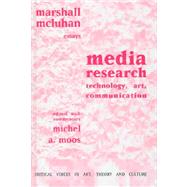
Media Research: Technology, Art and Communication
by Moos,MichelEdition: 1st
Format: Hardcover
Pub. Date: 1997-11-01
Publisher(s): Routledge
 Other versions by this Author
List Price: $160.00
Buy New
Usually Ships in 5-7 Business Days
$152.00
Rent Textbook
Select for Price
Digital
$36.96*
Used Textbook
We're Sorry
Sold Out
Summary
Herbert Marshall McLuhan (1911-1980) received his PhD in English literature from Cambridge University and taught in the United States and Canada. He is best known, however, as the founding father of media studies. McLuhan was Director of the Center for Culture and Technology at the University of Toronto. Among his ground-breaking works on the psychic and social dimensions of communication technology are The Gutenberg Galaxy(1962); Understanding Media: the Extensions of Man(1964); and The Medium Is the Massage: An Inventory of Effects(1967). Michel Moos' premise is that Marshall McLuhan's importance derives from his achievements in rethinking the entire process of education and training itself, not with his popular fame as media guru, and he analyzes McLuhan's work from the feedback effect his vision continues to provide, rather than from the perspective of interpreting McLuhan's pronouncements on the electronic media. Moos contrasts McLuhan's thoughts with those of such thinkers as Roland Barthes, Fredric Jameson, Friedrich Kittler, Donna Haraway, and Deleuze and Guattari, and renders an updated account of the effect of the mass media on our society and ourselves. The concept "the medium is the message" is the hub around which Marshall McLuhan's explorations revolved. McLuhan's interests ranged from sixteenth-century literature to twentieth-century business practices. With wit and literary flair, he reported the media's influence on society and on the individual. He concluded that we could not escape being transformed by the forces that are hidden deeply within the electronic telecommunications revolution of the sixties. For McLuhan, the new mediums of film, television, and the emerging realm of the digital were the modern equivalent of Gutenberg's printing press. Essays by M. McLuhan. Edited and with a Commentary by M.A. Moos.
Table of Contents
| Introduction to the Series | xi | (2) | |||
| Foreword | xiii | ||||
| Essays | 1 | (4) | |||
|
|||||
|
5 | (11) | |||
|
16 | (23) | |||
|
39 | (6) | |||
|
45 | (34) | |||
|
79 | (7) | |||
|
86 | (6) | |||
|
92 | (18) | |||
|
110 | (11) | |||
|
121 | (5) | |||
|
126 | (14) | |||
| McLuhan's Language for Awareness under Electronic Conditions | 140 | (27) | |||
|
|||||
| Notes | 167 |
An electronic version of this book is available through VitalSource.
This book is viewable on PC, Mac, iPhone, iPad, iPod Touch, and most smartphones.
By purchasing, you will be able to view this book online, as well as download it, for the chosen number of days.
Digital License
You are licensing a digital product for a set duration. Durations are set forth in the product description, with "Lifetime" typically meaning five (5) years of online access and permanent download to a supported device. All licenses are non-transferable.
More details can be found here.
A downloadable version of this book is available through the eCampus Reader or compatible Adobe readers.
Applications are available on iOS, Android, PC, Mac, and Windows Mobile platforms.
Please view the compatibility matrix prior to purchase.