
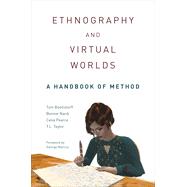
Ethnography and Virtual Worlds
by Boellstorff, Tom; Nardi, Bonnie; Pearce, Celia; Taylor, T. L.; Marcus, GeorgeFormat: Paperback
Pub. Date: 2012-08-27
Publisher(s): AMAZON
 Other versions by this Author
List Price: $30.68
Rent Textbook
Select for Price
New Textbook
We're Sorry
Sold Out
Used Textbook
We're Sorry
Sold Out
eTextbook
We're Sorry
Not Available
Summary
Ethnography and Virtual Worldsis the only book of its kind--a concise, comprehensive, and practical guide for students, teachers, designers, and scholars interested in using ethnographic methods to study online virtual worlds, including both game and nongame environments. Written by leading ethnographers of virtual worlds, and focusing on the key method of participant observation, the book provides invaluable advice, tips, guidelines, and principles to aid researchers through every stage of a project, from choosing an online fieldsite to writing and publishing the results. Provides practical and detailed techniques for ethnographic research customized to reflect the specific issues of online virtual worlds, both game and nongame Draws on research in a range of virtual worlds, including Everquest, Second Life, There.com, and World of Warcraft Provides suggestions for dealing with institutional review boards, human subjects protocols, and ethical issues Guides the reader through the full trajectory of ethnographic research, from research design to data collection, data analysis, and writing up and publishing research results Addresses myths and misunderstandings about ethnographic research, and argues for the scientific value of ethnography
Author Biography
Tom Boellstorff is professor of anthropology at the University of California, Irvine. His books include Coming of Age in Second Life: An Anthropologist Explores the Virtually Human. Bonnie Nardi is professor of informatics at the University of California, Irvine. Her books include My Life as a Night Elf Priest: An Anthropological Account of World of Warcraft. Celia Pearce is associate professor of digital media at Georgia Institute to Technology. Her books include Communities of Play: Emergent Cultures in Multiplayer Games and Virtual Worlds. T.L. Taylor is associate professor of comparative media studies at Massachusetts Institute of Technology. Her books include Play Between Worlds: Exploring Online Game Culture.
Table of Contents
| Acknowledgments | p. xi |
| Foreword | p. xiii |
| Why this Handbook? | p. 1 |
| Beginnings | p. 1 |
| Why ethnographic methods and why virtual worlds? | p. 6 |
| Why a handbook? | p. 8 |
| An orientation to the virtual worlds we studied | p. 9 |
| Three Brief Histories | p. 13 |
| A brief history of ethnographic methods | p. 13 |
| A brief history of virtual worlds | p. 22 |
| A brief history of research on virtual world cultures | p. 25 |
| The uses of history | p. 27 |
| Ten Myths About Ethnography | p. 29 |
| Ethnography is unscientific | p. 30 |
| Ethnography is less valid than quantitative research | p. 36 |
| Ethnography is simply anecdotal | p. 40 |
| Ethnography is undermined by subjectivity | p. 41 |
| Ethnography is merely intuitive | p. 42 |
| Ethnography is writing about your personal experience | p. 43 |
| Ethnographers contaminate fieldsites by their very presence | p. 44 |
| Ethnography is the same as grounded theory | p. 45 |
| Ethnography is the same as ethnomethodology | p. 46 |
| Ethnography will become obsolete | p. 48 |
| Research Design and Preparation | p. 52 |
| Research questions: emergence, relevance, and personal interest | p. 52 |
| Selecting a group or activity to study | p. 57 |
| Scope of the fieldsite | p. 59 |
| Attending to offline contexts | p. 61 |
| Participant Observation in Virtual Worlds | p. 65 |
| Participant observation in context | p. 65 |
| Participant observation in practice | p. 69 |
| Preparing the researching self | p. 72 |
| Taking care in initiating relationships with informants | p. 76 |
| Making mistakes | p. 79 |
| Taking extensive fieldnotes | p. 82 |
| Keeping data organized | p. 85 |
| Participant observation and ethnographic knowledge | p. 87 |
| The timing and duration of participant observation | p. 88 |
| The experimenting attitude | p. 90 |
| Interviews and Virtual Worlds Research | p. 92 |
| The value of interviews in ethnographic research | p. 92 |
| Effective interviewing | p. 94 |
| The value of group interviews in ethnographic research | p. 104 |
| Size, structure, and location for group interviews | p. 106 |
| Transcription | p. 110 |
| Other Data Collection Methods for Virtual Worlds Research | p. 113 |
| Capturing chatlogs | p. 113 |
| Capturing screenshots | p. 114 |
| Capturing video | p. 116 |
| Capturing audio | p. 117 |
| Data collection in other online contexts | p. 118 |
| Historical and archival research | p. 120 |
| Virtual artifacts | p. 121 |
| Offline interviews and participant observation | p. 124 |
| Using quantitative data | p. 126 |
| Ethics | p. 129 |
| The principle of care | p. 129 |
| Informed consent | p. 131 |
| Mitigating institutional and legal risk | p. 135 |
| Anonymity | p. 136 |
| Deception | p. 142 |
| Sex and intimacy | p. 144 |
| Doing good and compensation | p. 146 |
| Taking leave | p. 148 |
| Accurate portrayal | p. 149 |
| Human Subjects Clearance and Institutional Review Boards | p. 151 |
| Institutional Review Boards (IRBs) | p. 151 |
| Preparing a protocol for KB review | p. 153 |
| Working with IRBs | p. 155 |
| Informed consent and anonymity | p. 156 |
| Data Analysis | p. 159 |
| Ethnographic data analysis: flexibility and emergence | p. 159 |
| Preliminary reflections while in the field | p. 160 |
| The role of theory in data analysis | p. 162 |
| Beginning data analysis: systematize and thematize | p. 164 |
| Working with participant observation data | p. 168 |
| Working with individual and group interview data | p. 170 |
| Working with images, video, and textual data | p. 172 |
| The end of the data analysis phase: from themes to narratives and arguments | p. 174 |
| Generalization and comparison | p. 176 |
| Writing Up, Presenting, and Publishing Ethnographic Research | p. 182 |
| The early stages of writing up: conferences, drafts, blogs | p. 182 |
| Written genres | p. 185 |
| Dissemination | p. 186 |
| The writing process | p. 190 |
| A quick trip back to the field? | p. 192 |
| Tone, style, and audience | p. 193 |
| Conclusion: Arrivals and New Departures | p. 196 |
| References | p. 201 |
| Index | p. 223 |
| Table of Contents provided by Ingram. All Rights Reserved. |
An electronic version of this book is available through VitalSource.
This book is viewable on PC, Mac, iPhone, iPad, iPod Touch, and most smartphones.
By purchasing, you will be able to view this book online, as well as download it, for the chosen number of days.
Digital License
You are licensing a digital product for a set duration. Durations are set forth in the product description, with "Lifetime" typically meaning five (5) years of online access and permanent download to a supported device. All licenses are non-transferable.
More details can be found here.
A downloadable version of this book is available through the eCampus Reader or compatible Adobe readers.
Applications are available on iOS, Android, PC, Mac, and Windows Mobile platforms.
Please view the compatibility matrix prior to purchase.